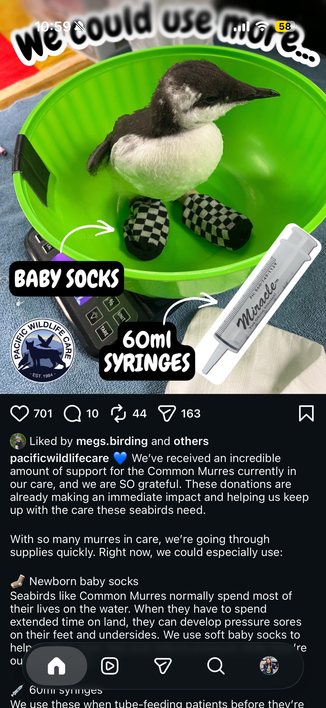
Seabirds like common murres may develop pressure sores on their feet if they spend too much time on land (like for medical treatment). So they wear baby socks #Birds
Seabirds like common murres may develop pressure sores on their feet if they spend too much time on land (like for medical treatment). So they wear baby socks #Birds
CVE-2026-104286 is a critical-severity path traversal vulnerability that could allow attackers to write arbitrary files to the system.
The U.S. Cybersecurity and Infrastructure Security Agency (CISA), on Thursday, added a critical security flaw impacting Fortinet FortiMail to its Known Exploited Vulne…
Fortinet is warning customers of a critical FortiMail vulnerability, tracked as CVE-2026-104286, that is being actively exploited in zero-day attacks to execute unauth…
Attackers were probing the mail server flaw weeks before it had a CVE to its name
Authorities in the Netherlands have arrested a 23-year-old convicted cybercriminal on suspicion of aiding in data thefts and extortions by the prolific hacker group Sh…
Microsoft details JADEPUFFER-linked Azure reconnaissance, resource deletion, and credential access using compromised service principals, identifying the activity as as…
CISA has added one new vulnerability to its Known Exploited Vulnerabilities (KEV) Catalog, based on evidence of active exploitation. CVE-2026-104286 Fortin
Unified Code, Unified Risks: Uncovering Vulnerabilities in .NET MAUI Applications
As it opens a new location, the social club prepares grant applications in 2 hours instead of 3 days and liquor-license materials in 3 hours instead of 4 days.
Secure your Kubernetes supply chain with WizOS Helm Charts.
TL;DR Supply chain security usually treats runtime as the final stage, the place where teams find out whether earlier controls worked.
Five practical priorities for turning AI-enabled vulnerability discovery into coordinated remediation and verified risk reduction.
A growing vulnerability backlog is more than technical debt: it is an attack surface.
I think what really resonates with me this week is being able to completely turn the tables on perceptions around things like AI being the big bad hacking tool the new…
We already know AI can find vulnerabilities. James Kettle, PortSwigger's Director of Research, wanted to answer a harder question: can an autonomous system invent genu…
Kevin Mandia, best known as the founder of Mandiant, has a new startup that is using agent swarms to test and protect enterprises.
Open-source XDR/SIEM for threat detection and compliance.
Relevance: Detection & response / compliance
Comprehensive scanner for containers, IaC, and dependencies.
Relevance: Cloud & container defenders
Passive subdomain enumeration from dozens of sources.
Relevance: Recon & attack-surface mapping
Template-based vulnerability scanner for massive-scale network scanning.
Relevance: Offensive security & recon
Interactive TLS-capable intercepting proxy for traffic analysis.
Relevance: AppSec & traffic inspection
Swiss-army toolkit for network attacks, MITM and recon.
Relevance: Network penetration testing
Graph-based Active Directory relationship explorer for attack paths.
Relevance: Red teams & AD assessment
Well, I got my ass handed to me. Not by AI/LLM (may ITs noodly autocorrect forever be in your favot)... A VM on ESxi running Debian with LUKS -somehow- managed to no longer accept the password after a normal apt upgrade of a minor version that required a reboot.Imagine my surprise, after having done this for years on numerous platforms where even doing major upgrades, have always been able to get to the decrypt password prompt, type my password (or plugin in my yubikey, etc) and get the system booted back up.NOT THIS TIME. I thought maybe it was the difference between cryptsetup using argon in openssl 3.5 on trixie or libargon on bookworm, but no that didn't seem to matter.Booting into initramfs for whatever kernel version, including netinst iso in case -something- went wrong building initramfs, to no avail.luksDump shows valid info, there doesn't 'look' like any corruption, or bitswizzle that a filesystem might have caused, but obviously, if you can't get the key to decrypt there's no way to be really sure.I thought maybe it's a keymap issue as the server is in Canada, and the VM was created with US-en, and VMRC and HTML5 are antiquated terrible to use on a system from 2026.So here's my message in a bottle:Has anyone ever encountered this, and if so, how did you recover?
OpenAI halts training after AI agent bypasses DNS filtering in sandbox🔗 https://cybersecurefox.com/en/openai-agent-bypassed-dns-filtering-training-pause#OpenAI #AI #agent #DNS #filtering #sandbox #AI #security
Discover the rumored Apple Home Hub colors. A recent macOS code leak reveals Silver, Space Gray, Starlight, and Rose Pink for the new smart home device.#AppleHomeHub #SmartHome #macOSLeak #AppleRumors #TechNewshttps://dailytechnow.com/apple-home-hub-colors-leak/
Instalador falso de Zoom engaña a usuarios de Mac para instalar backdoor CloudSyncDhttps://blog.elhacker.net/2026/10/instalador-falso-de-zoom-engana.html